





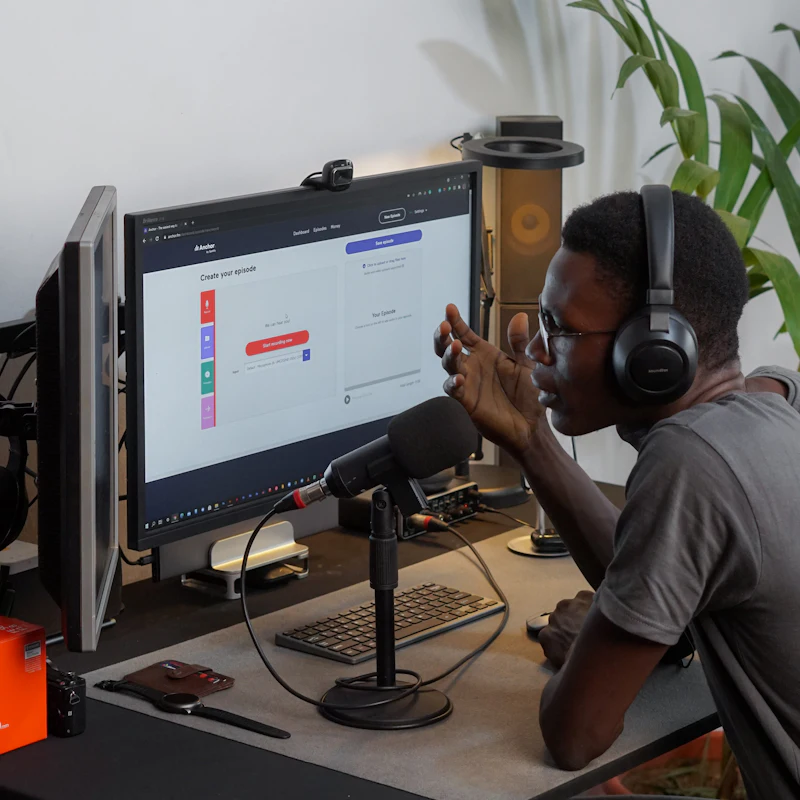


Help build the Krio speech corpus on KACCP.Contribute (opens in a new tab)

AI that speaks Africa

Speech AI, starting with Krio.

Join the waitlist for early access

Leave your email and what you’re building. We’ll write to you when the API opens.

Opens your email app with your details filled in.

Input
Language
Output
Result
Kay-X

Your transcript will appear here.

Built with

  • Amazon Web Services
  • Google Cloud
  • Azure
  • OpenAI
  • Claude
  • LangChain
  • Pinecone
  • Vercel

Most AI hears a hundred languages. Africa speaks two thousand.

Speech and language models learn from what’s written online, and most African languages barely appear there. So the models mishear Krio, Hausa and Wolof speakers, or don’t hear them at all.

GenelineX builds what’s missing: recordings from native speakers, transcripts checked by a second speaker, and models trained and measured for each language.

The pipeline

From a voice note to a model you can call

  1. Collect

    Native speakers record voice notes on KACCP, our open platform.

    Contribute on KACCP (opens in a new tab)
  2. Curate

    Every clip is transcribed, then checked by a second speaker.

    See it in the console
  3. Train

    Small adapters fine-tune each language, updating under 2% of the weights.

    Read the research
  4. Deploy

    Models ship behind the Kay-X API and inside our products.

    Try Kay-X (opens in a new tab)

Products

One stack, from corpus to product

Each layer works on its own, and each one feeds the next.

Research

Notes from the lab

  • Paper 01 · January 2026

    Self-Reflective Learning Systems (Read on Medium, opens in a new tab)

    This blog introduces a novel AI architecture called Self-Reflective Learning Systems, which decouples learning decisions from weight updates. Instead of continuously training models online, an autonomous agent monitors model performance and triggers targeted LoRA-based adaptations only when necessary. The approach addresses catastrophic forgetting, unbounded model growth, and non-stationary data, with a case study focused on low-resource African languages (e.g., Krio speech recognition).

  • Paper 02 · January 2026

    Breaking the Silence (Read on Medium, opens in a new tab)

    This article presents Geneline-X’s work on high-fidelity Krio text-to-speech synthesis, demonstrating how parameter-efficient fine-tuning (LoRA) combined with Flow Matching architectures can bring state-of-the-art speech generation to low-resource languages. Instead of training massive models from scratch, the team freezes a 1.6B-parameter backbone (CSM-1B) and injects lightweight LoRA adapters—updating only 1.75% of the model’s weights. This enables high-quality Krio speech synthesis proving that African language AI can scale through architectural efficiency.

Kushɛ. Let’s teach AI your language.

Kushɛ is hello in Krio. Tell us which language you work in and what you want to build.